
Transformative Cabinet Decisions of 24th September 2025: Boosting Maritime Strength, Healthcare, Infrastructure, and Employment for a Self-Reliant India
₹95,000 Crore Investment Package Fueling 44 Lakh Jobs, 10,000+ Medical Seats, and Strategic Growth in Maritime, Infrastructure, and Research.
On 24th September, 2025, the Cabinet Committee on Economic Affairs (‘CCEA’) chaired by the Prime Minister Shri Narendra Modi Ji announced six major decisions in the areas of education, employee benefits, Rail connectivity, Road connectivity and the maritime sector. Together, these measures involve an outlay of nearly ₹ 95,000 crore, the creation of over 44 lakh employment opportunities, and major expansions in both healthcare and infrastructure.
The key highlights include: a ₹ 69,725 crore maritime package projected to generate 30 lakh jobs, approval of 10,023 additional medical seats (₹ 15,034 crore), launch of a ₹ 2,277 crore CSIR scheme for research and human capital, sanction of a ₹ 1,865 crore productivity-linked bonus for 10.91 lakh railway employees, construction of a ₹ 3,822 crore greenfield highway in Bihar creating over 31 lakh man-days of employment and doubling of 104 km Bakhtiyarpur – Rajgir – Tilaiya single railway line section in Bihar with total cost of ₹ 2,192 crore.
I. Four-Pillar Package to Strengthen Shipbuilding and Maritime Sector :
The CCEA has approved a comprehensive ₹ 69,725 crore package to strengthen India’s maritime ecosystem through a four-pillar approach. The initiative focuses on capacity building, long-term financing, infrastructure development, and policy reforms to achieve global competitiveness and strategic self-reliance (Aatmanirbhar Bharat).
Financial Incentives (SBFAS): The Shipbuilding Financial Assistance Scheme is extended till 2036 with a ₹ 24,736 crore corpus, including a ₹ 4,001 crore Shipbreaking Credit Note to support domestic shipbuilders.
Maritime Development Fund (MDF): A ₹ 25,000 crore long-term financing facility has been created, comprising a ₹ 20,000 crore Maritime Investment Fund and a ₹ 5,000 crore Interest Incentive Fund to lower borrowing costs.
Capacity Development (SbDS): With an outlay of ₹ 19,989 crore, this scheme will expand domestic shipbuilding capacity to 4.5 million Gross Tonnage annually, set up mega clusters, and establish the India Ship Technology Centre.
Policy Reforms: Legal, taxation, and regulatory reforms have been mandated to create a robust and globally competitive ecosystem for shipbuilding and maritime services.
Impact: The package is expected to unlock 4.5 million GT of shipbuilding capacity, generate 30 lakh jobs, and attract ₹ 4.5 lakh crore investment into the sector
Strategic Goal: This initiative strengthens India’s maritime competitiveness and self-reliance, crucial as 95% of the nation’s trade is handled through sea routes.
II. Expansion of Postgraduate and Undergraduate Medical Education Capacity :
The Cabinet Committee on Economic Affairs approved Phase-III of the Centrally Sponsored Scheme (CSS) to boost both postgraduate (PG) and undergraduate (MBBS) medical seats across the country by strengthening and upgrading existing government medical institutions.
5,000 additional postgraduate seats will be created through upgradation of government medical colleges, PG institutes, and hospitals.
5,023 additional MBBS seats will be added with an enhanced cost ceiling of ₹1.50 crore per seat.
The total financial implications of these two schemes are ₹ 15,034.50 crore for a period from 2025-26 to 2028-29. Out of ₹ 15,034.50 crore, the central share is ₹ 10,303.20 crore and the state share is ₹ 4,731.30 crore.
The decision builds on 127% growth in MBBS and 143% growth in PG seats in the past decade, aligning with the goal of Universal Health Coverage (UHC) for 1.4 billion people.
III. DSIR Scheme on Capacity Building and Human Resource Development :
The CCEA has approved a ₹ 2,277.40 crore CSIR-led scheme (2021–26) to nurture India’s scientific talent under the Fifteenth Finance Commission cycle.
The scheme will be implemented by CSIR and covers all major research institutions across the country, including R&D institutions, national laboratories, Institutes of National Importance, Institutes of Eminence, and Universities to provide a platform for young researchers in Science, Technology, Engineering, Medical, and Mathematical Sciences (STEMM), thereby increasing the researchers per million population and strengthening India’s science and technology sector.
The programme will span R&D institutions, national laboratories, Institutes of National Importance, and universities, offering fellowships, research grants, awards, and symposia support.
This funding is a direct investment in the next generation of Indian researchers by placing them under the mentorship of eminent scientists. It aims to boost researchers per million population, strengthen India’s STEMM ecosystem, and position the country for global scientific leadership.
IV. Productivity Linked Bonus for Railway Employees :
The CCEA has approved a Productivity Linked Bonus of ₹ 1,865.68 crore of 78 days for about 10.91 lakh non-gazetted railway employees, with a maximum payout of ₹ 17,951 each.
The decision is based on record performance in 2024–25, with 1,614.90 MT cargo loaded and 7.3 billion passengers carried.
The bonus will be disbursed before Durga Puja/Dussehra, serving as a festive incentive.
It recognises the workforce’s contribution, boosts morale, and motivates continued efficiency gains in Indian Railways.
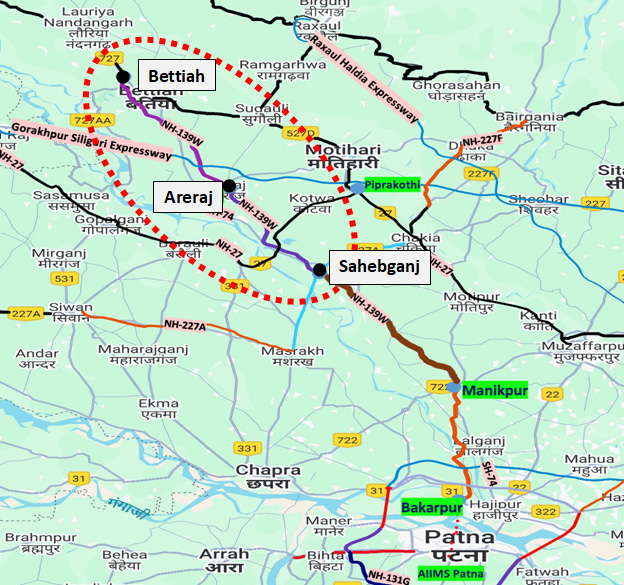
V. Construction of 4-Lane Sahebganj–Areraj–Bettiah Section of NH-139W in Bihar :
The CCEA has approved construction of a 78.94 km 4-lane greenfield highway in Bihar at a cost of ₹ 3,822.31 crore, designed on the Hybrid Annuity Mode to bypass older, congested roads and ensure faster, safer travel.
The project will connect Patna with Bettiah and the Indo-Nepal border, strengthening links across seven North Bihar districts including Vaishali, Muzaffarpur, and East and West Champaran, while enabling average vehicle speeds of 80 km/h and cutting travel time by more than half.
It will act as an economic artery, linking seven PM Gati Shakti economic nodes, six social nodes, and eight logistics nodes, improving access to industrial and agricultural zones and giving a major boost to regional trade and connectivity.
The highway will also enhance Bihar’s tourism potential by connecting nine major religious and cultural sites like Kesariya Buddha Stupa and Vishwa Shanti Stupa, while generating over 31 lakh man-days of employment during the construction phase.
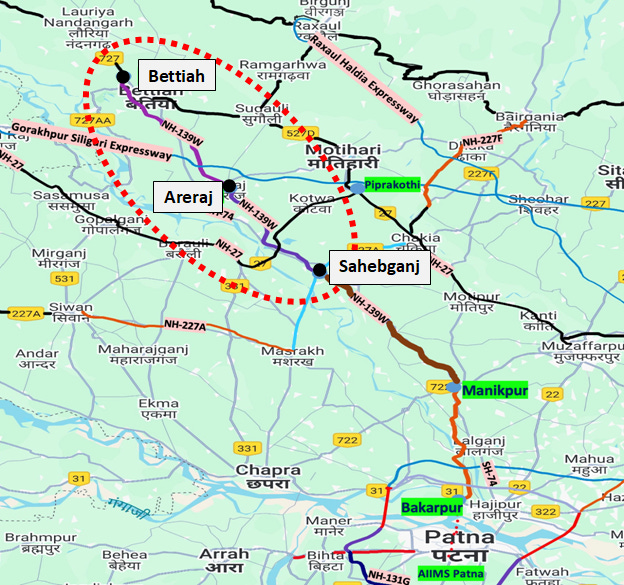
Image 1: Project Alignment Map for Sahebganj-Areraj-Bettiah section of NH-139W
VI. Doubling of Bakhtiyarpur – Rajgir – Tilaiya Railway Line in Bihar :
The CCEA has approved the doubling of the 104 km Bakhtiyarpur – Rajgir – Tilaiya railway section at an estimated cost of ₹ 2,192 crore, covering four districts in Bihar.
The project will increase the Indian Railways network by 104 km and enhance connectivity to prominent destinations like Rajgir (Shanti Stupa), Nalanda, and Pawapuri, attracting pilgrims and tourists nationwide.
Multi-tracking will improve access for approximately 1,434 villages and 13.46 lakh people, including the Aspirational Districts of Gaya and Nawada, while boosting freight capacity by 26 MTPA for commodities such as coal, cement, and fly ash.
The environmentally friendly railway expansion will help reduce oil imports by 5 crore litres, cut 24 crore kg of CO2 emissions (equivalent to planting 1 crore trees), and lower logistics costs, supporting climate goals.
The enhanced line will improve mobility, operational efficiency, and service reliability, aligning with PM-Gati Shakti National Master Plan for multi-modal connectivity and fostering regional employment and self-reliance.
The Cabinet Committee on Economic Affairs (CCEA) has taken a landmark set of decisions with a combined outlay of nearly ₹95,000 crore, aimed at driving transformative growth across critical sectors including maritime, healthcare, scientific research, railways, and infrastructure development. These measures are expected to generate over 44 lakh employment opportunities, significantly expand medical education capacity aligning with the goal of Universal Health Coverage, and bolster India’s scientific talent and innovation ecosystem through the CSIR-led scheme.
The comprehensive maritime package comprising capacity building, long-term financing, infrastructure development, and policy reforms will enhance India’s strategic self-reliance and global competitiveness in shipbuilding, unlocking 4.5 million Gross Tonnage capacity and attracting ₹4.5 lakh crore investment. The approval of productivity-linked bonuses for railway employees rewards record performance and boosts morale while infrastructure projects like the construction of a 4-lane highway and doubling of an important railway line in Bihar will improve connectivity, economic activities, and regional employment, supporting PM Gati Shakti’s vision of multimodal transport and sustainable development.
Overall, these decisions reiterate a forward-looking governance approach aimed at inclusive growth, strategic autonomy, and strengthening India’s domestic capacities, thereby positioning the nation for greater economic resilience, social welfare, and global leadership in key sectors.